AA59569 Commercial Item Description & Scope
Intended for use in both commercial and industrial applications
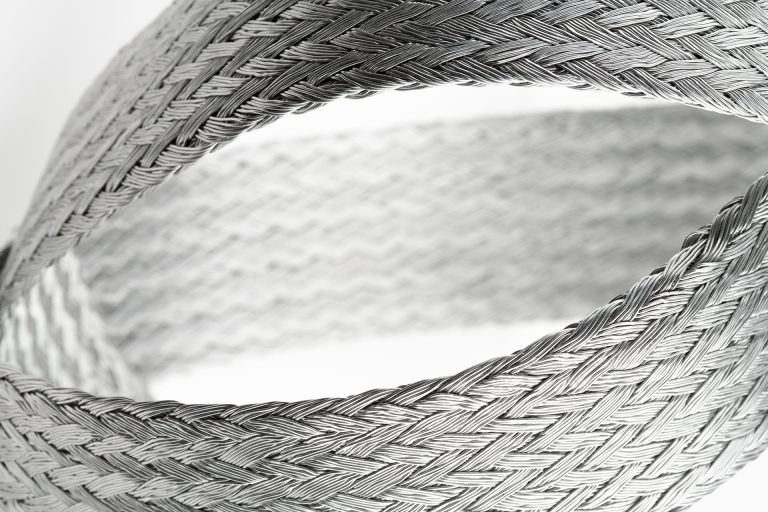
Federal Specification QQ-B-575C, dated September 22, 1993, was cancelled on November 20, 2000, and replaced by Commercial Item Description (CID) A-A-59569. This CID covers tinned, silver-, or nickel-plated copper wire braids supplied in tubular or flat form intended for use in commercial/industrial applications such as shielding over electrical conductors, controller contacts and grounding bonds.
ASTM Standards, Plating Specifications & Temperature Ratings
In accordance with the specification, the wire used by New England Wire Technologies for all braid constructions conforms to ASTM B33 for tinned copper, ASTM B298 for silver-plated copper, and ASTM B355 for nickel-plated copper. Per the CID, all braid constructions utilizing silver-plated copper meet the specs minimum plating thickness of 40 micro-inches and all constructions manufactured with nickel-plated copper meet the required 50 micro-inches plating minimum thickness.
Silver-plated copper is used when the shielding is to be subjected to temperatures exceeding 150° C while nickel-plated copper is recommended for high temperature applications up to 400°C. Both silver and nickel-plated copper offer improved corrosion resistance as compared to tinned copper.
Engineers Ask: AA59569 Braids FAQs
How do I select between tinned, silver-plated, and nickel-plated braid for my specific application?
Your choice of braid conductor material will depend on a few factors, such as the conductivity and solderability requirements of your application, temperature limits and corrosion resistance, as well as cost and availability.
For instance, tin-plating is considered “general purpose”, has lower electrical conductivity, but excellent solderability. While it provides good corrosion and chemical resistance it offers little improvement to operating temperature. As compared to silver-plating or nickel-plating, tin plating is also typically the lowest cost option.
Silver-plating has the highest electrical performance with excellent electrical conductivity. It offers very good corrosion and chemical resistance and is easy to solder. Silver-plating is especially useful in RF, high-frequency, and high-performance electrical applications, however, the additional cost is a consideration.
In the average to higher price range, nickel-plating is often used in extreme environments due to its heat durability and excellent corrosion and chemical resistance. However, soldering can be difficult and often requires an activated flux.
For more information on wire plating, check out these resources:
Can AA59569 braids be customized beyond the standard specification?
Yes, they can! We can build to the intent of the AA59569 braid standard, but customize for additional specific application criteria and performance. Common customizations include the use of non-standard conductor materials, single end AWG size, braid diameters, custom widths (including extra-wide and flattened options), and heavy current versions. We can also offer additional extruded insulations and cut lengths.
What electrical or mechanical properties should I consider when sizing a braid?
The most important factors to think about when selecting your braid are:
- Required shielding effectiveness – including coverage and attenuation
- Operating temperature rating & plating
- Recommended size relative to cable diameter; and
- Flexibility and minimum bend radius for installation purposes
With these properties in mind, we can help guide you to the correct braid size for your application.
What’s the difference between AA59569 and the old QQB575 specification?
Short answer – there is no practical difference. AA59569 is the modern commercial item description (CID) that directly replaced and supersedes the old QQB575 federal specification. If your spec or drawing calls for a QQB575 braid, you can seamlessly use an AA59569 braid as a direct replacement.