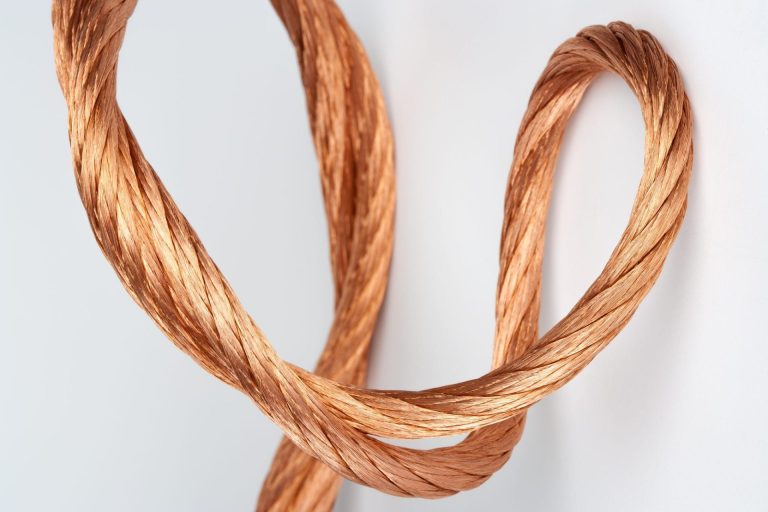
We specialize in designing rope lay cables, concentric and miniature bunched strands that offer the ultimate in flexibility. These stranded constructions complement our specialty insulated wire products, where flexibility and extended flex life are primary concerns.
Bending Stress Reduction & Flex-Life Mechanic
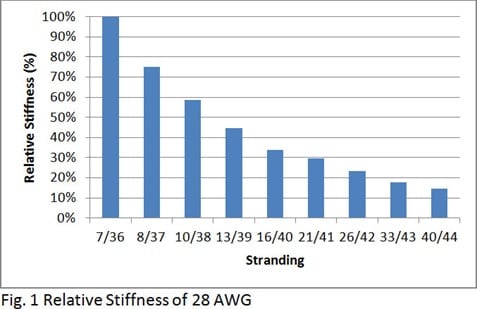
By combining smaller wire gauges into larger conductors, the overall conductor’s geometric resistance to bending and therefore it’s stiffness, is reduced as demonstrated in Fig. 1 comparing the stiffness percentage of several 28 AWG stranding (7/36 is considered to be 100% in this example).
In addition to reducing stiffness, smaller gauge sizes also develop less stress when subjected to bending. As a result conductors with finer stranding will survive a larger number of bending cycles without suffering fatigue in comparison to a conductor manufactured with a coarser single end wire.
Conductor Construction Methods: Bunching, Stranding & Cabling
Bunching
Bunching is a high-speed operation that allows for large number of ends of wire to be assembled by twisting them together through a rotating arm, commonly in a non-planetary operation. In a bunch, each end has no definite place to occupy in the final construction; as a result, ends can (and will) shift and float freely. This allows for a non-concentric number of ends to be used and improves the packing density in comparison to stranding or cabling, at the expense of reduced flexibility and some introduced twist in the individual wires.
Stranding
Stranding is performed on a semi-planetary cabler. These machines impart little to no twist into the wire making it an excellent option for applications that require high strength or low elongation alloys.
Cabling
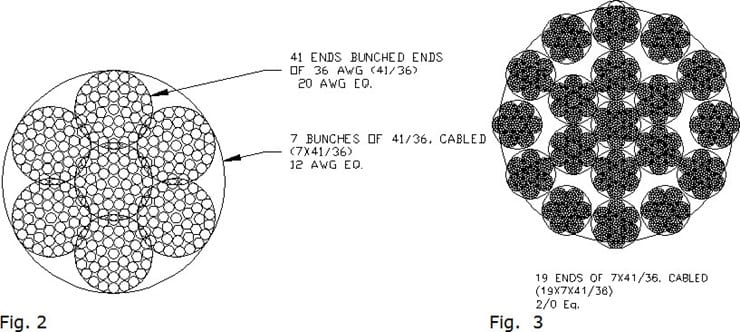
For applications that require flexibility at larger conductor sizes, New England Wire offers ultra flexible ropelay cables. In cabling, fully planetary cablers rotate each spool of wire as it is cabled adding no additional twist into the wire. This improves cable flexibility, reduces cable memory, and improves the overall aesthetics of the final product by maintaining a circular shape better than a bunched conductor.
Engineers Ask: Ultra Flexible Strands FAQs
How do I choose between a bunch, concentric stranding, or a ropelay?
Choose a bunched conductor when the overall AWG required isn’t too large and when you want a good flexible conductor at a lower cost to manufacture.
Choose a concentric stranded conductor when concentricity and roundness are important, when looking for a more stable configuration, and when alloy conductors are needed so as not to impart back twist into the conductor strands.
Choose a ropelay conductor when the overall AWG size is large, when looking for large power cables, and when seeking excellent continuous flexibility.
How does conductor size affect which construction to choose?
Any type of stranded conductor uses multiple ends of a smaller AWG size to build the overall conductor up to a larger AWG conductor. At certain points it just becomes clear to move from one type of stranded conductor to another. A bunched conductor, even using multiple bunching operations has limits, and in such a case it only makes sense to look at a ropelay cable, for example.
How do requirements like flexibility, flex life, cable memory, and packing density affect which construction to choose?
Conductor configuration does play a part in all these performance criteria, but it is only one consideration. Other factors to consider include: single end conductor size, the number of cabling operations, lay length, and conductor material to name a few. It is best to have a clear understanding of the application and the performance needs of the conductor. Discuss these requirements with a technical member of our team and we will help you design the best option for your needs.