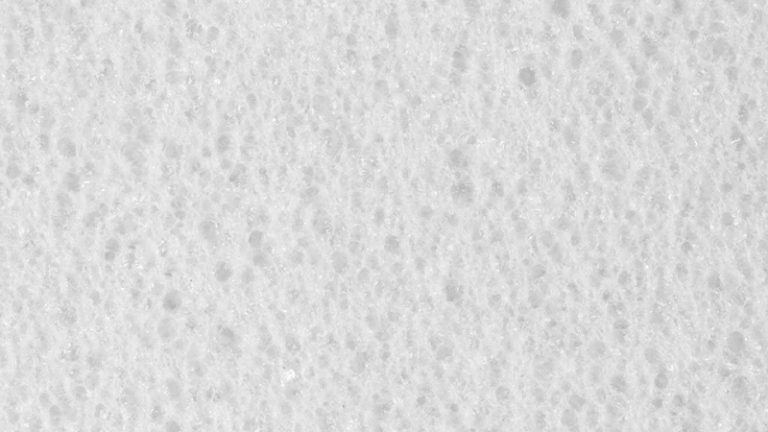
NEWcel® is a closed-cell foamed dielectric material specifically designed to reduce dielectric constant and dissipation factor yielding low-capacitance, low-loss, high velocity of propagation (VOP) coaxial, triaxial, and twinaxial offerings.
The Challenge of Signal Speed vs. Structural Integrity
Air is a near perfect dielectric medium allowing a signal to propagate through it at approximately the speed of light. However, an air dielectric is impractical for use as cable insulation as it provides no structural integrity, forcing manufacturers into using materials with higher dielectric constants (lower VOP) to meet physical restrictions. Typical coaxial, triaxial, and twinaxial cables are manufactured using low dielectric constant (2.0-2.6) materials that possess inherently better electrical properties than standard insulation material such as PVC.
The NEWcel® Solution & Performance Advantages
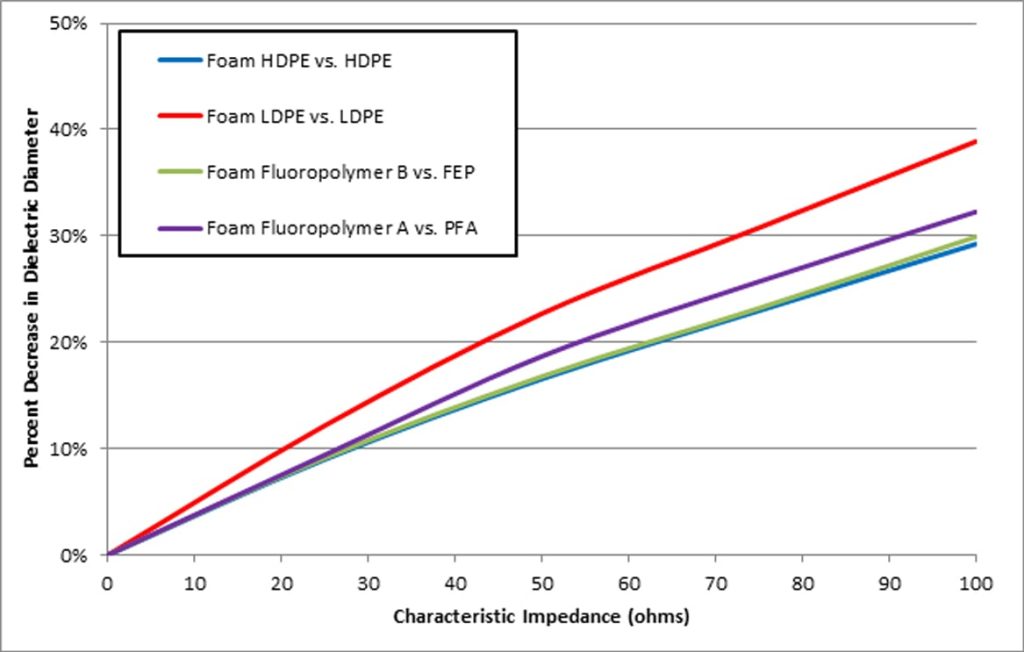
NEWcel® is the perfect solution. Using highly controlled extrusion processes, these materials are foamed yielding a dielectric medium with a high air concentration. The result of this process is a significantly reduced dielectric constant (1.43-1.75) that approaches the nearly ideal properties of air without sacrificing structural integrity. This reduced dielectric constant results in lower capacitance, smaller builds, and improved attenuations when compared to solid insulations.
Key Product Advantages:
- Reduces Attenuation
- Reduces Cable Size
- Reduces Capacitance
- Wide Temperature Range
Performance Metrics & Dimensional Comparisons
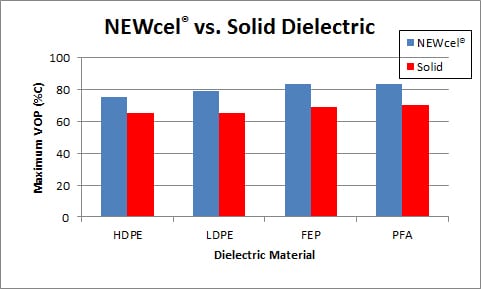
| Solid HDPE | Solid LDPE | Foam HDPE | Foam LDPE | Solid FEP | Solid PFA | Foam FEP | Foam PFA | |
|---|---|---|---|---|---|---|---|---|
| VOP (%C) | 65.6 | 66.2 | 75.6 | 81.6 | 70.2 | 70.2 | 81.9 | 83.6 |
| Suggested Temp Limit | 75°C | 75°C | 75°C | 75°C | 200°C | 250°C | 200°C | 250°C |
| Minimum Wall (inches) | 0.004″ | 0.006″ | 0.008″ | 0.018″ | 0.002″ | 0.001″ | 0.010″ | 0.0035″ |
| Maximum Wall (inches) | 0.050″ | 0.065″ | 0.022″ | 0.100″ | 0.065″ | 0.035″ | 0.030″ | 0.015″ |
| Dielectric Constant | 2.32 | 2.28 | 1.75 | 1.50 | 2.03 | 2.03 | 1.49 | 1.43 |
Engineers Ask: NEWcel Foamed Dielectric FAQs
Is foamed dielectric primarily for high-frequency applications?
Air is the best insulator, so using a foamed dielectric with tiny air pockets improves the overall VOP (velocity of propagation), or the speed at which signal travels through the cable. This is ideal for high-frequency applications.
When does lower capacitance become important?
As VOP increases both dielectric constant and capacitance decrease. Because capacitance is the ability of the cable to store electrical energy (usually a bad thing) the higher the capacitance, the more frequency signal loss, or attenuation. That means the lower the capacitance, the better the cable performance will be over greater distances.
Are there applications where a solid dielectric is actually the better choice?
Sure, not every cable needs foam dielectric, as solid layers generally provide improved crush resistance. Should the cable be exposed to heavy weight, tight bends, or pinching the foamed layer can easily crush and ruin electrical performance. Therefore, applications such as high-flex robotics, which sees repeated bends, or underground burial cable where dirt can put tremendous weight on the cable, or even high-power cables that see voltages high enough where electrical arcing can occur across the tiny air pockets of a foam dielectric.
What are the mechanical or cost tradeoffs?
Well, introducing air into the dielectric is an additional process and requires tight measurement controls of both physical characteristics and electrical values. This additional processing and oversight does result in a higher cost. It is important to evaluate the initial cost versus the performance criteria in application to see if a foamed dielectric is the right choice.
In terms of mechanical tradeoffs, we have already talked a bit about them but here is the summary. Foamed dielectrics have tiny pockets of air that improve VOP but that does weaken the physical characteristics of the plastic insulation. This means the foam dielectric will be more susceptible to damage when bent around a tight radius, flexed repeatedly, if the cable is under a heavy weight load, etc. These and other mechanical stresses can crush or pinch the foam dielectric layer, causing physical and electrical performance issues.
NEWcel clearly offers electrical advantages, but when are those advantages significant enough to matter?
Whenever lower signal loss, faster signal speed, or it dealing with longer transmission distances a foamed dielectric will be superior over a solid dielectric layer.