Triboelectric Noise Suppression & Signal Integrity
In small-signal applications, noise-free transmission lines are necessary to maintain signal integrity. Simply flexing or twisting a traditional cable can generate voltage spikes with magnitudes in the tens of millivolts. This noise is due to triboelectric charging of the insulator materials, which act as capacitors and store the charge. The addition of conductive low noise layers reduces the noise to the microvolt range.
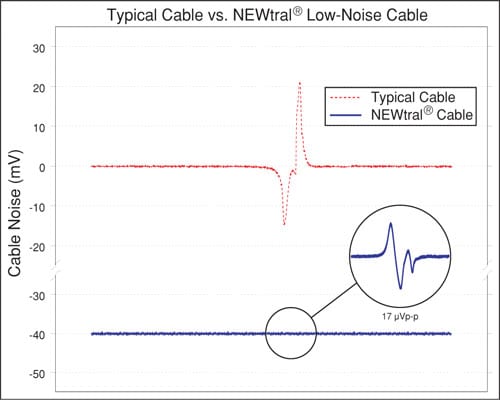
Low noise layers are typically either a coating or an extruded layer, and sometimes a combination of both.
While preparing a low noise cable for termination, it is important to consider the effect of the outer conductive low noise suppression layer. Isolation of the low noise layer from the conductors is necessary to prevent a short circuit situation. Depending on the type, the low noise layer can either be stripped with conventional mechanical and laser methods (extruded layers), or will require chemical and abrasive stripping methods (coating layers).
Engineers Ask: NEWtral® Low Noise Cable FAQs
When should I choose an extruded low-noise layer?
If the application can handle a slightly larger diameter, or if ease of stripping off the conductive low-noise layer is preferred, then an extruded layer is an excellent choice. The extruded conductive layer is a distinguishable, separate layer that can be stripped with conventional mechanical and laser methods. However, due to the conductive fillers in the extrusion layer the thickness does build more than the coating options.
When is a coating preferable?
When minimal build is desired, as the coated layers build the least out of any low-noise option. In addition, this option is relatively cost effective compared to other conductive layer options. Keep in mind though, this layer will need to be chemically stripped during termination.
How much build to the outer diameter does each option add?
Coatings build the least with a range of .0005” to .001”. An extruded layer typically builds .004”-.020” in diameter.
Is there a typical noise-performance range?
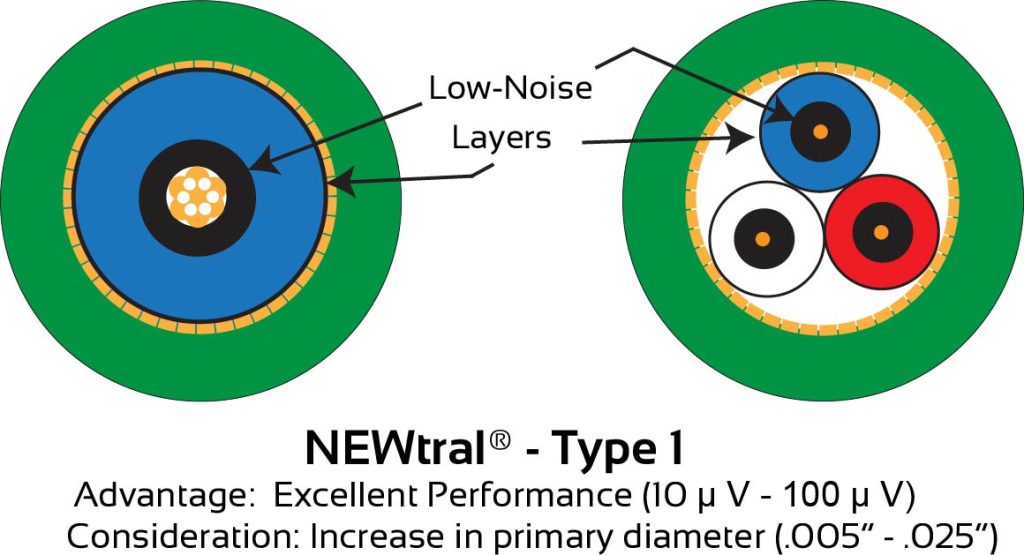
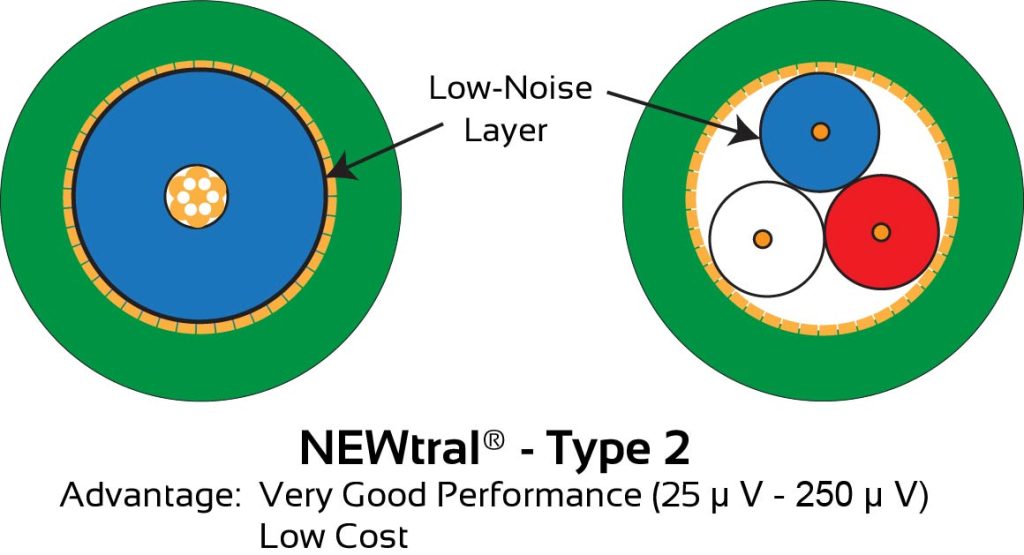
Yes, with a low-noise layer over the dielectric, performance is very good, typically in the 25µV-250µV range. Applying low-noise layers over both the conductor and the dielectric provides excellent performance in the 10µV-100µV range.