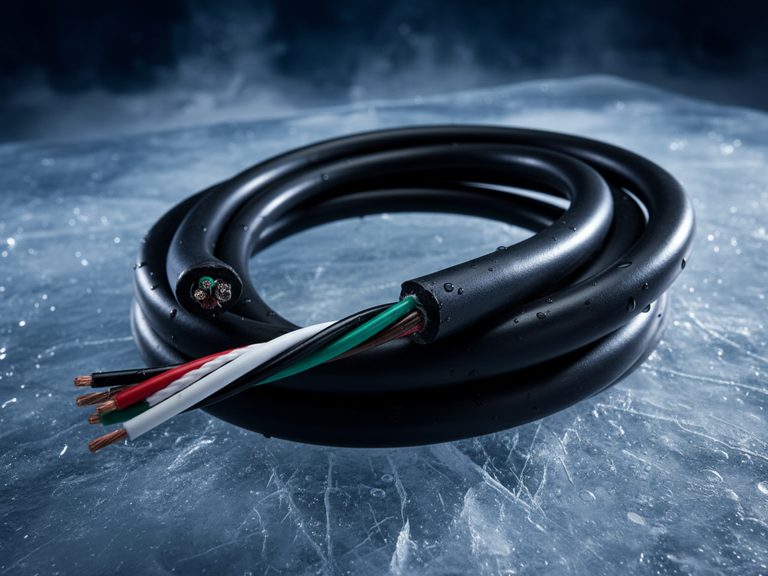
When developing a cable solution to meet the challenges of extreme temperature it is not enough to only consider the outer jacket. Every aspect of the cable including conductor material and plating selection, primary insulation, fillers, tapes, shields and of course the jacket must be carefully selected. New England Wire Technologies stocks a wide range of materials to allow for quick turnaround of custom options to meet specific low and high temperature performance requirements.
Cold Temperature & High Temperature Performance Factors
Cold Temperature Limits
At very cold temperatures typical wire and cable materials will lose flexibility or become brittle. When bent or flexed these materials can crack or even shatter. For low temperature applications cable components must be selected that will retain flexibility and plasticity. It is difficult to provide a generic low temperature limit for complex multi-conductor cable as suitability will depend on thickness, location within the cable and the particular bending requirements of the application. When a cable will be pushed to the limits testing on the completed cable is needed to guarantee that performance requirements will be met. Qualification typically involves utilizing prototype cable in the actual application or New England Wire can perform cold bend testing around a mandrel representative of the end use.
High Temperature Limits
When exposed to high temperatures cable materials will experience loss of tensile strength, diminished electrical properties and other problems long before catastrophic failure occurs. Therefore unlike cold limits, hot temperature limits are often best investigated on the individual material level. Heat resistance and retention of properties can be tested for each component and then the lowest rated component becomes the limiting factor for the overall cable temperature rating. That being said, New England Wire Technologies does have the capability to perform heat aging of completed cable to verify suitability.
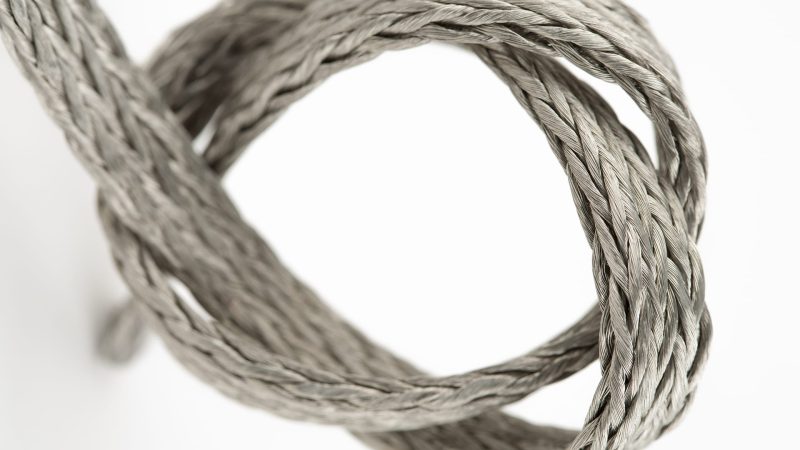
Conductor/Shield Wire Ratings
- Silver Plated Copper = 200° – 250°C depending on size and silver-plating thickness
- Nickel Plated Copper = 250°C
- 27% Nickel Plated Copper = 450° – 550°C depending on wire size and application
- Stainless Steel = 250°C
Extruded Insulation & Jacket Material Performance
- Fluoropolymer(PFA, FEP, ETFE) – Typically used for primary insulation or thin jackets as this family of compounds is not very flexible. However, fluoropolymers retain properties over a very wide range of temperatures. PFA is acceptable for use from -200°C to 250°C.
- Polyester– Like Fluoropolymers, Polyesters are not very flexible so are often used for primary insulation and thin jackets. Polyesters retain properties down to -100°C and below.
- TPE– Softer material that is often used for jackets and has excellent retention of flexibility at low temperatures. Includes NEWT COLDflex™ which remains incredibly flexible down to -40°C and has been used successfully as low as -100°C and NEWT HYflex™ which meets SAE J1127 requirements for 125°C use.
- Silicone Rubber– Extremely flexible thermoset material typically used for jackets. Most grades acceptable for -75°C to 150°C but specific grades can extend down to -90°C and up to 250°C.
High-Temperature Tapes, Fillers & Textiles
Tapes:
- Polyimide – General grades acceptable up to 350°C
- PTFE – 250°C
- Mica-mat – Up to 600°C
- Nomex® – General grades acceptable up to 226°C (Nomex® is a registered trademark of DuPont)
- Woven Fiberglass – E-glass to 260°C, S-glass to 450°C
Fillers/Textiles:
- PTFE/PFA Monofilament – 260°C
- Fiberglass – E-glass to 260°C, S-glass to 450°C
- Aramid – 160°C
Note: Operating temperature values are typical only and will depend on requirements and exact grades selected
Engineers Ask: Multi-Conductor Cable for Extreme Temperatures FAQs
How do I determine the actual temperature rating of a complete multi-conductor cable?
As the saying goes, “you are only as strong as your weakest link.” The same is true for temperature ratings for multi-conductor cables. Therefore, it usually comes down to the specific operating temperature ratings of the selected materials within the multi-conductor cable.
Is the jacket rating the cable rating?
No, the jacket’s temperature rating doesn’t automatically result in the overall cable’s temperature rating. The completed multi-conductor cable temperature limit depends on all components within the cable and will be restricted based on the component with the lowest rating.
Does conductor plating limit maximum temperature?
It can, as different plating materials have different operating temperatures. Typically, bare and tin-plated copper are rated to 150C, silver-plated copper 200C to 250C, and nickel-plated can be rated at 260C to 450C (depending on thickness). However, in most cases, the insulation material may have a lower operating temperature than any of the above plating limits, and as such the lowest operating temperature will drive the overall rating.
Should continuous operating temperature and short-term exposure be treated differently?
Yes, these are not the same. Continuous operating temperature is just what it sounds like, the multi-conductor cable can perform as intended over the life of the product. Short-term exposure may expose the multi-conductor to thresholds above normal operating conditions that result in thermal aging and material degradation. When this happens the chemical structures in the materials do not return to normal, leading to premature damage and failure.