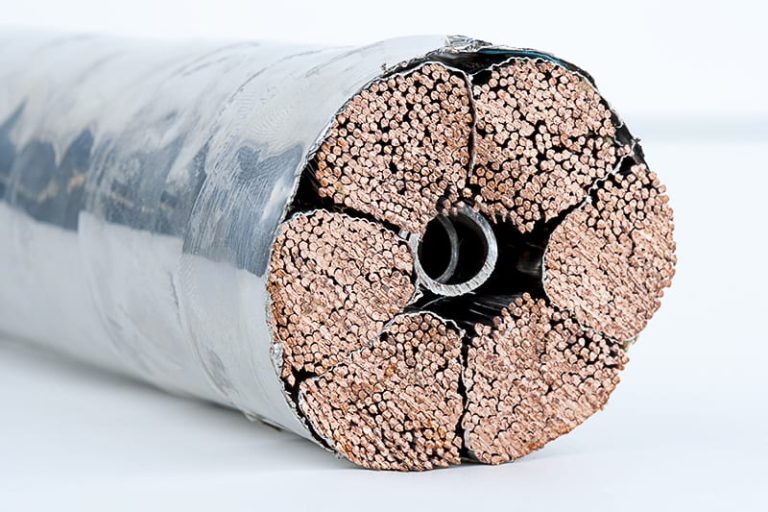
New England Wire Technologies has provided cabling, insulating, and other services to the superconductor industry since the 1960’s.
Major Research Projects & Global Magnet Applications
Our products are integrated into most of the major accelerator projects, ore separator magnets, NMR magnets, and superconducting magnetic energy storage (SMES) magnets. Other projects include Tevatron at Fermilab, RHIC for Brookhaven National Labs, LHC for Cern, 45 Tesla Hybrid Magnet for NHMFL, 36 strand Rutherford cable for GSI-Darmstadt FAIR, and high temperature superconductor wires for American Superconductor and various MRI manufacturers. New England Wire is also the only US manufacturer of Toroidal Field coils for the ITER (International Thermonuclear Experimental Reactor) project in southern France. Learn more about the ITER project here.
Geometries, Rutherford Cabling & Insulation Options
With the widely diversified stranding and cabling processes utilized at New England Wire Technologies, we are able to offer a broad range of special application items including round, rectangular and trapezoidal configurations of superconducting cables. We have experience with both low temperature and high temperature conductors, and we’re a world leader in Rutherford cabling of superconducting wire. We have the ability to apply polyimide tape, fiberglass tape, fiberglass textile braid, extruded ETFE insulation and engineered materials to all conductor configurations.
Engineers Ask: Superconductor Cabling FAQs
What configurations can NEWT cable superconductor materials?
NEWT offers a wide variety of cable configurations – typically round, rectangular, and trapezoidal – to meet the needs of the High Energy Physics community.
What is Rutherford cable—and when is it used?
Rutherford cable is made with a specialized cabling process developed by Rutherford Laboratory in England. It consists of cabling or twisting wires together and flattening the strands into a compact flat, rectangular, or trapezoidal cross-section. Often used in high energy physics applications such as particle accelerators for winding magnets, the compaction and shape allow for higher conductor density than that of a traditional round cable. Trapezoidal or keystone cross-sections allow for neat, compact circular stacked winding configurations.
How do you cable superconducting wire without damaging its performance?
That’s our trade secret! 😉