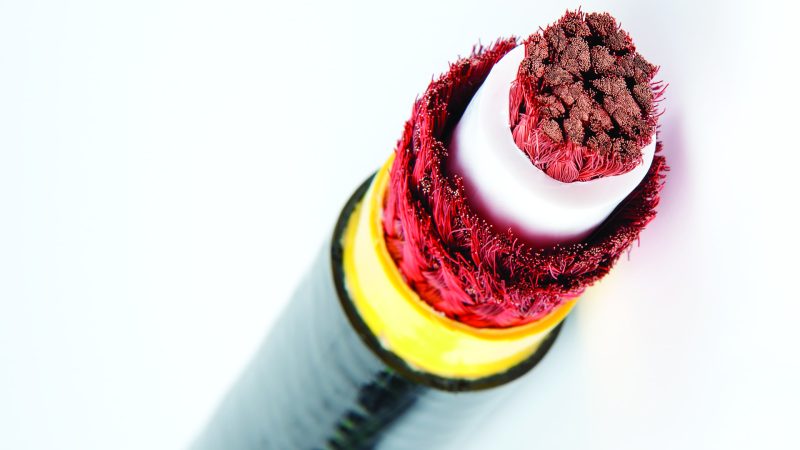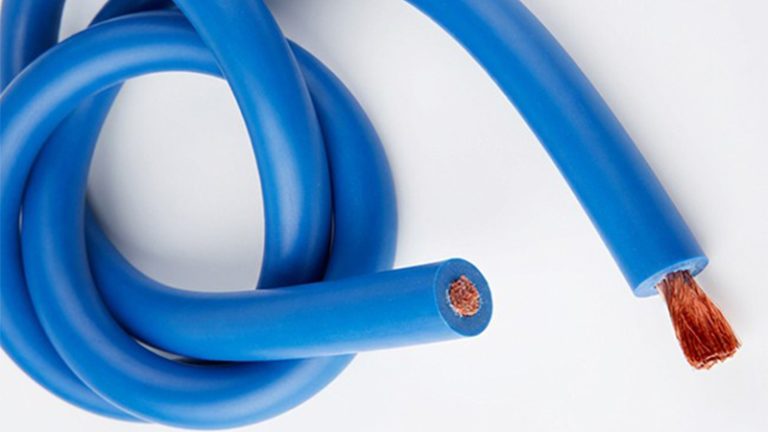
Wire and cable is often required to withstand mechanical motion and maintain useable properties. New England Wire Technologies has considerable experience in design and materials to extend flex life in standard and rigorous use situations.
While we test for many existing cable standards including a myriad of UL, CSA, ISO (agency multi) and other standards, the most important standard to meet is high performance in application. Specialized test fixtures have been developed in conjunction with the customer to more precisely match use. This allows tests to more accurately predict life or give better information to extend life.
Application-Specific Testing & Custom Flex Life Optimization
Smaller gauge sizes develop less stress when subjected to bending. As a result, conductors with finer stranding will survive a larger number of bending cycles without suffering fatigue in comparison to a conductor manufactured with a coarser single end wire.
Conductor Stranding, High-Tensile Alloys, and Insulation Selection
High tensile strength copper alloys can be used to increase longevity with little impact to conductivity and other electrical parameters while tinsel can be used for ultimate flex life when resistance is not an important parameter.
Selection of plastics for longevity and flex life is critical in designing for long life as well. Harder abrasion resistant plastics work well but choices are also available that maintain flexibility and flex life.
Engineers Ask: Extended Flex Life Cable FAQs
What’s the difference between flexibility and flex-life?
Flexibility refers to how easily the cable moves when handled. Flex-life is a function of how many times you can bend the cable before it breaks down.
View this video for additional information: Flex-life vs. flexibility
How is cable flex-life measured?
Generally, flex-life is measured in cycles. One cycle is the bending or rotation of the cable from its original position through the movement and back to its original position.
What determines flex-life?
There are several factors to consider. First, it is important to understand what type of flex-life is needed for the application. For example, will the cable see radial flexing, torsional, or some other repeated movement and how often and how harsh are these flex cycles?
Material selection is important for cables that need a long flex-life. Alloy conductors, which handle repeated cycles without incurring as much damage as typical conductors, are often used. Likewise, selecting insulations that are formulated to resist deformation, and resist fatigue is important. For multi-conductor cables, a uniform cable with similar components that equally share the distribution of stress on the cable is ideal, however, that isn’t always an option and results in the need to implement other techniques such as: component layout, strategic use of filler material, and tightness of subsequent operations, including the overall jacket, to improve the cable’s flex-life.
Can increasing flexibility reduce durability?
It can. Flexible cables typically use softer, flexible materials and the cable design generally allows conductors and components to move within the cable. This movement introduces rubbing, friction, and stress which can weaken the cable and lead to failure over time due to increased fatigue and deformation.
Getting the correct balance between flexibility and flex-life can be super important.
Can New England Wire test to my application’s specific motion?
Yes, we can. We have many different types of flex testing equipment that attempts to simulate movement in real-world scenarios.